Vadzo Imaging Positions Bolt-5640CRA: OV5640 5MP Autofocus MIPI Camera with Automatic Image Control for Kiosks and Digital Signage
Built for self-service kiosks, digital signage, and interactive displays that need to resolve a user's face or a
Press Release Disclaimer: This is a press release distributed through the XPR Media network. It has not been independently verified by our newsroom.

Built for self-service kiosks, digital signage, and interactive displays that need to resolve a user’s face or a scanned item clearly regardless of height or distance from the screen, this camera pairs the OmniVision OV5640 sensor with VCM autofocus and Automatic Image Control over MIPI CSI-2, giving kiosk manufacturers dependable image quality without a USB connector or external ISP to manage.
FORT WORTH, TX / ACCESS Newswire / August 21, 2026 / Vadzo Imaging, a provider of embedded vision solutions, today positioned the Bolt-5640CRA, a 5MP Autofocus MIPI Camera built around the OmniVision OV5640 sensor for self-service kiosks, digital signage, and interactive display applications that need dependable autofocus and consistent image quality across a wide range of users and lighting conditions.
Why Kiosks and Digital Signage Need a 5MP Autofocus MIPI Camera Built for Varying Users
Self-service kiosks and interactive displays face a focus challenge that most fixed security or industrial camera products never encounter: the subject in front of the camera changes constantly, and not just in position. A kiosk camera capturing a face for age verification, a scanned item held up to a reader, or a signature at a checkout terminal has to resolve subjects standing at different heights, holding items at different distances, and approaching the screen from different angles, often within the same few minutes of continuous operation. A fixed focus lens set for one average distance leaves every user outside that narrow range with a blurred result.
A VCM Autofocus MIPI Camera solves that problem by adjusting focus electronically for each new subject, rather than asking a kiosk operator to manually refocus the camera or accepting blur for users who do not match the original installation assumptions. This matters directly for kiosk applications where a blurred capture is not just an inconvenience; it can mean a failed identity check, an unreadable scanned code, or a signage camera that cannot accurately count who actually looked at a display.
A second, related challenge is exposure and color consistency across the lighting conditions a kiosk or signage installation actually experiences. Retail lobbies, transit stations, and outdoor kiosk enclosures all present different and sometimes rapidly changing lighting, which is where Automatic Image Control MIPI Camera processing becomes as important as autofocus itself in delivering a usable capture on the first attempt rather than after repeated retries.
Neither challenge exists in isolation on a real kiosk floor. A user approaching a self-service terminal on an overcast afternoon presents both a new focus distance and a different lighting condition than the person who used the same kiosk an hour earlier under direct sun through a nearby window. A camera that solves focus but not exposure, or the reverse, still leaves a kiosk manufacturer troubleshooting inconsistent results that appear to have no clear pattern, when in fact two separate but related limitations are compounding each other.
Engineering Explanation: Focus and Image Control Working Together
OmniVision designed the OV5640 specifically for embedded applications that need dependable autofocus and image processing in a compact, MIPI-connected package. As an OV5640 Autofocus MIPI Camera, the sensor pairs 5 megapixel resolution with an integrated VCM autofocus lens assembly, giving kiosk manufacturers a single module that resolves both distant signage viewers and close-up item scans without a lens change or a second camera. As an OmniVision OV5640 Camera, it targets exactly this kind of kiosk and signage deployment needing both capabilities from one module rather than a camera adapted from an unrelated application.
Automatic Image Control, or an AIC MIPI Sensor Module, is the onboard feature that handles exposure, white balance, and banding filter correction directly on the sensor rather than requiring an external image signal processor. As an OV5640 Sensor, the module continuously adjusts these settings as lighting changes throughout a kiosk’s operating day, which matters directly for installations near windows, under variable indoor lighting, or in outdoor enclosures exposed to changing weather. A 5MP Automatic Image Control Camera configuration like this one gives kiosk manufacturers consistent image quality without adding a separate processing stage to their system design.
VCM autofocus and Automatic Image Control work together rather than solving separate problems. As a 5MP VCM Autofocus Camera, the Bolt-5640CRA adjusts both focus and exposure automatically as a new user approaches or lighting shifts, so the module remains ready for the next interaction without requiring recalibration between users. An Auto Exposure MIPI Camera configuration like this one is particularly valuable for high-traffic kiosk deployments where consistent image quality across hundreds of daily interactions matters more than any single capture looking perfect.
MIPI CSI-2 connectivity completes the design for kiosk and signage integration. As a 5MP MIPI Camera, the Bolt-5640CRA connects directly to the MIPI CSI-2 interface already built into most embedded processors used in kiosk and signage hardware, avoiding the additional USB controller or bridging hardware a USB-connected camera would require in that same design.
Product Overview
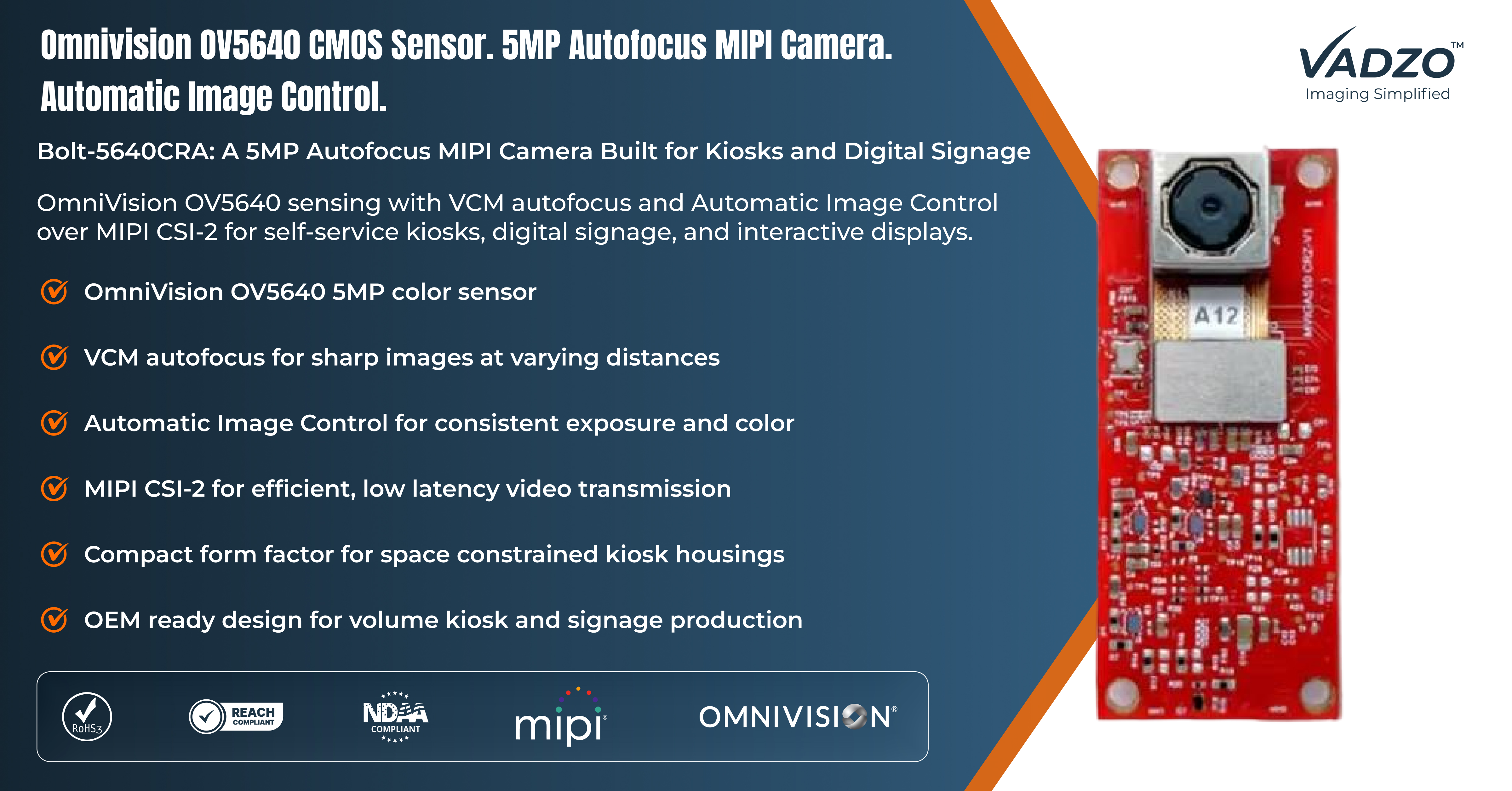
The Bolt-5640CRA pairs the OV5640 MIPI Camera sensor with VCM autofocus and Automatic Image Control in a compact design suited to kiosk, signage, and interactive display integration. As a 5MP Autofocus MIPI Camera, it outputs full 5-megapixel resolution with autofocus and exposure control active by default, giving kiosk manufacturers a single camera platform that covers identity verification, item scanning, and audience analytics from one module.
At the core of the module sits the OV5640 5MP MIPI Camera sensor, chosen specifically for the combination of autofocus range and onboard image processing that kiosk and signage applications require. Because the camera pairs OV5640 5MP Sensor capture with a 5MP MIPI Camera Module interface, the Bolt-5640CRA integrates directly into embedded processor platforms already common in kiosk and signage hardware, without the added complexity of a USB bridge or external controller.
Product Specifications
Sensor: OmniVision OV5640 CMOS Sensor
Sensor Size: 1/4 inch
Pixel: 1.4 µm × 1.4 µm
Resolution: 5MP (2592 × 1944)
Shutter: Rolling shutter
Interface: 2 Lane MIPI CSI-2
Key Capabilities
OmniVision OV5640 Sensor for Detailed 5MP Capture: The Bolt-5640CRA is built around the OmniVision OV5640 sensor, a 5-megapixel device that resolves fine detail for identity verification, item scanning, and signage audience analysis from the same hardware. This gives the module genuine 5MP Autofocus Sensor Module performance suited to kiosk applications that need to examine a face, a document, or a scanned code with enough resolution for the task at hand.
VCM Autofocus for Sharp Images Across Varying Distances: A kiosk camera encounters a new subject at a potentially different distance with every interaction, whether that is a shorter user standing closer to the screen or an item held up at arm’s length for scanning. The included VCM autofocus lens assembly adjusts electronically for each of these situations, keeping the subject in focus without requiring a technician to tune the lens for a single assumed distance that may not match how the kiosk is actually used. As a 5MP VCM Autofocus MIPI Camera, the Bolt-5640CRA delivers that adjustment automatically across the full resolution range the sensor supports.
Automatic Image Control for Consistent Exposure and Color: Kiosk and signage installations rarely sit in perfectly controlled lighting, and a camera that only performs well under one specific lighting condition produces inconsistent results as ambient light shifts throughout the day. As a Digital Signage Camera, the Bolt-5640CRA’s onboard Automatic Image Control adjusts exposure and color continuously, keeping image quality consistent whether a kiosk sits near a window, under indoor lighting, or in a partially outdoor enclosure.
MIPI CSI-2 for Efficient, Low Latency Video Transmission: Most embedded processors used in kiosk and signage hardware already include a native MIPI CSI-2 interface, which makes a MIPI-connected camera a more direct fit than a USB camera requiring an additional controller or bridging chip. As a MIPI CSI-2 Kiosk Camera, the Bolt-5640CRA connects directly to that existing interface, reducing both the bill of materials and the design complexity of a kiosk manufacturer’s camera integration.
Compact Form Factor for Space-Constrained Kiosk Housings: Kiosk and signage enclosures are often designed around a display and payment module first, leaving limited space for a camera and its supporting electronics. The Bolt-5640CRA’s compact board-level design fits into that remaining space without forcing a kiosk manufacturer to redesign an enclosure around the camera’s footprint, which matters directly for retrofit installations adding camera capability to an existing kiosk product line. A manufacturer updating an established kiosk design to add vision capability generally has far less flexibility to expand the enclosure than a team designing a brand new product from scratch, which makes a camera’s physical footprint a real constraint rather than a minor specification.
OEM Ready Design for Volume Kiosk and Signage Production: Kiosk and signage manufacturers producing units at scale need a camera platform that stays consistent across a long production run rather than changing specifications between batches. Vadzo Imaging supports full customization on this platform as an OEM Kiosk Camera Module, including connector changes, lens selection, and firmware adjustments for manufacturers headed into volume production across multiple kiosk or signage product lines.
“Kiosk manufacturers keep telling us the same thing: their camera products have to work for every user who walks up, not just the average-height person the installation was originally tested with. The OV5640’s VCM autofocus combined with Automatic Image Control gives the Bolt-5640CRA the flexibility to handle that variation automatically, over a MIPI interface that fits directly into the embedded processors kiosk manufacturers already use. We built this camera for installations that run unattended for years, not for a single controlled demo.” – Alwin Vincent – Product Manager at Vadzo Imaging.
Application-Specific Sections
Self-Service and Interactive Kiosks: Self-service kiosks handling identity verification, ticketing, or item scanning need a camera that resolves each new user or item clearly regardless of height or distance from the screen. As a Self-Service Kiosk Camera, the Bolt-5640CRA’s autofocus handles that variation automatically, and functioning as an Interactive Kiosk Camera, it extends the same reliability to general touchscreen and interactive display applications.
Digital Signage and Audience Analytics: Digital signage systems measuring audience engagement and dwell time depend on a camera that captures viewers clearly across a range of distances and lighting conditions near the display. As a Smart Kiosk Camera Module, the Bolt-5640CRA supports that analytics function, and functioning as a Smart Kiosk Vision Camera, it extends the same capability to broader interactive signage applications beyond simple audience counting. As an Audience Analytics Camera, it supports exactly that measurement task alongside its broader signage vision capability.
Vending Machines and Automated Retail: Automated retail and vending platforms verifying age, confirming item selection, or documenting a transaction need a compact camera that fits within an already tightly packed enclosure. A Vending Machine Camera Module built on this platform fits that space constraint, and its autofocus keeps items and faces in focus despite the limited, fixed mounting positions typical of a vending cabinet. Because vending and automated retail enclosures are rarely redesigned once tooling is finalized, a camera module that fits the existing space without modification is often the deciding factor in whether a vision upgrade is practical to add to an established product line at all.
Interactive Displays and Touchscreens: Interactive displays used for wayfinding, product lookup, or customer feedback benefit from a camera that can also support basic audience awareness features without adding significant hardware complexity. An Interactive Display Camera Module built around the OV5640 adds that capability directly, and functioning as a Signage Vision Camera Module, it integrates cleanly into a display’s existing embedded processor rather than requiring separate camera electronics.
OEM Integration for Kiosk Manufacturers: Kiosk and signage manufacturers building their own hardware platforms need a camera vendor who understands the space, connectivity, and consistency requirements those products demand across a long production run. The Bolt-5640CRA ships from a Kiosk Camera Manufacturer with those requirements built in, and Vadzo Imaging supports OEM customization for cable length, connector type, and lens selection for manufacturers standardizing on one camera across multiple kiosk or signage products. As a MIPI Camera for Kiosks, it fits directly into a manufacturer’s existing embedded processor design without requiring a redesign around a new camera’s specific requirements.
Frequently Asked Questions
Q: Why does a kiosk or signage camera need autofocus when the camera itself is usually mounted at a fixed position?
A: The camera’s mounting position may be fixed, but the subject in front of it is not, since a kiosk serves users of different heights holding items at different distances, and a signage display may be viewed from a range of distances depending on where someone happens to stand. A fixed focus lens set for one average distance produces a blurred result for every user who falls outside that narrow range, which is a real problem when the capture is being used for identity verification, code scanning, or accurate audience measurement. Vadzo Imaging includes autofocus on its kiosk camera products specifically because a fixed mounting point does not mean a fixed subject distance, and a camera that only works well for an average user is not actually solving the problem a real kiosk deployment presents. That gap between a controlled test and everyday foot traffic is often what separates a camera that looks good in a demo from one that continues to perform reliably months into an actual deployment.
Q: What is Automatic Image Control, and how is it different from basic auto exposure?
A: Basic auto exposure typically adjusts only the brightness of a captured frame in response to available light. Automatic Image Control extends that idea to also manage color balance and banding artifacts caused by certain types of indoor lighting, correcting several image quality factors together rather than exposure alone. Vadzo Imaging selects sensors with genuine Automatic Image Control for kiosk and signage applications because these installations often sit under fluorescent or LED lighting that can introduce banding or color shifts a basic exposure-only correction would not address, and a camera that only solves part of the lighting problem still produces inconsistent results across a kiosk’s operating day.
Q: Why would a kiosk or signage manufacturer choose a MIPI camera instead of a USB camera?
A: Most embedded processors used in kiosk and signage hardware already include a native MIPI CSI-2 camera interface, which means a MIPI-connected camera plugs directly into that existing hardware without an additional USB controller or bridging chip. Choosing a USB camera in that same design adds a component that was not otherwise necessary, along with the driver and enumeration overhead that comes with it. Vadzo Imaging offers its kiosk camera products in a MIPI-connected format specifically because it matches the interface kiosk and signage processors already provide, reducing both bill of materials cost and design complexity for manufacturers building at volume. That simplification also reduces the number of components a manufacturer needs to source, test, and support over a product’s lifetime, which matters as much for long-term maintenance and field support as it does for the initial bill of materials at launch.
Q: Can Vadzo Imaging customize a kiosk camera module for a specific self-service or vending platform?
A: Yes. Vadzo Imaging supports full OEM customization across its kiosk camera portfolio, including lens selection suited to a specific viewing distance, connector and cable configuration matched to a particular embedded processor board, and firmware adjustments tuned for a specific autofocus or Automatic Image Control profile. Evaluation units ship with no minimum order requirement, and the same engineering team that built the standard product works directly with kiosk and signage manufacturers to adapt the module for a specific self-service, vending, or display platform headed into volume production.
Q: What should kiosk and signage manufacturers look for when choosing a camera supplier for a multi-unit product line?
A: A camera that performs well in a single prototype unit does not automatically perform the same way once a manufacturer is producing hundreds or thousands of units across a product line, since small variations in autofocus consistency, image processing, or component sourcing can compound at that scale. Manufacturers should look for a supplier who can maintain consistent hardware and firmware across a long production run, provide direct engineering support during integration, and offer a connectivity approach that matches the embedded hardware already used in the product rather than adding unnecessary components. Vadzo Imaging builds its kiosk camera products around exactly these priorities, since a camera vendor’s real value shows up during volume production, not just an initial prototype demonstration. A vendor who can answer specific questions about firmware update paths, long-term part availability, and support for design changes discovered mid-production is generally a stronger long-term partner than one who can only speak to a single unit’s specifications.
Availability
The Bolt-5640CRA 5MP Autofocus MIPI Camera is available now for evaluation and OEM integration. Evaluation kits include the camera module, a factory-calibrated lens, MIPI CSI-2 cable options suited to common embedded processor boards, and integration documentation covering autofocus configuration and Automatic Image Control setup, with no minimum order requirement. Contact Vadzo Imaging at support@vadzoimaging.com to request an evaluation unit or discuss volume production and OEM customization. Evaluation feedback is also welcome directly through the same contact channel, since real deployment conditions across a pilot installation often surface details a bench test alone would not reveal, and that feedback helps confirm a configuration before a manufacturer commits to a full production order.
About Vadzo Imaging
Vadzo Imaging develops embedded and machine vision camera products for OEMs, system integrators, and kiosk and signage manufacturers building production-ready vision systems across self-service retail, digital signage, security, and edge AI. The company’s portfolio spans MIPI CSI-2, USB, GigE, Wi-Fi, FPD-Link III, and SerDes interface camera products, supporting deployment architectures from compact onboard modules to distributed networked installations. Vadzo provides end-to-end imaging support, including sensor integration, ISP tuning, firmware development, and SDK frameworks to accelerate system deployment, and the company’s engineering team works directly with customers throughout evaluation, pilot deployment, and volume production rather than handing off support after the initial sale. That ongoing relationship is particularly valuable for kiosk and signage programs, where a product may remain in production and in the field for many years after its initial launch. Visit Vadzo Imaging to explore the full embedded vision camera portfolio.
Media Contact
Alwin Vincent
Vadzo Imaging
Email: alwin@vadzoimaging.com
LinkedIn: Vadzo Imaging
YouTube: Vadzo Imaging
X: Vadzo Imaging
SOURCE: Vadzo Imaging
View the original press release on ACCESS Newswire
Media gallery