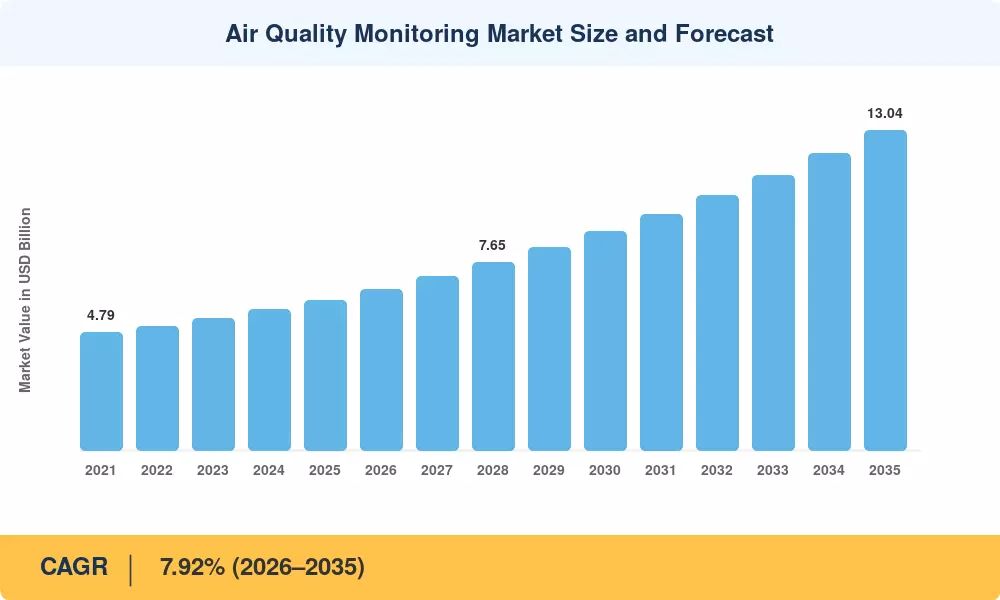
Air Quality Monitoring Market to Reach USD 13.04 Billion by 2035, Growing at 7.92% CAGR
Asia-Pacific leads the air quality monitoring market at 38% share, with China and India collectively operating more
Press Release Disclaimer: This is a press release distributed through the XPR Media network. It has not been independently verified by our newsroom.

Asia-Pacific leads the air quality monitoring market at 38% share, with China and India collectively operating more than 12,000 continuous monitoring stations.
NEW YORK, NY, UNITED STATES, August 27, 2026 /EINPresswire.com/ — According to Market Research Future, the Air Quality Monitoring Market is projected to reach USD 6.57 Billion in 2026 before climbing to USD 13.04 Billion by 2035, registering a CAGR of 7.92% during the forecast 2026 to 2035, driven by Integration of advanced sensors and IoT technology. This steady growth reflects the escalating global focus on environmental health, where real-time air quality monitoring has become essential for public safety, regulatory compliance, and sustainable urban development.
Market Overview
Air quality monitoring systems encompass a comprehensive range of hardware, software, and services designed to detect, measure, and analyze pollutants in both ambient outdoor environments and indoor spaces. These systems utilize advanced sensor technologies, gas analyzers, and particulate matter detectors to track concentrations of harmful pollutants including nitrogen oxides, sulfur oxides, volatile organic compounds, carbon monoxide, and particulate matter. The market serves diverse end-users including government agencies, industrial facilities, healthcare institutions, commercial buildings, and residential consumers who increasingly prioritize health and environmental sustainability.
The key growth drivers propelling this market expansion include the alarming rise in air pollution levels due to rapid industrialization, urbanization, and increased vehicular emissions across the largest economies worldwide . Growing public health awareness regarding the links between air pollution and respiratory diseases, cardiovascular conditions, and other health complications has generated immense demand for continuous air pollution monitoring equipment . Stricter regulations set forth by governments and environmental protection agencies regarding emissions control have further contributed to the increase in market share . The increasing adoption of IoT-enabled monitoring systems and AI-powered analytics is enhancing real-time monitoring accuracy, predictive capabilities, and operational efficiency .
Technological developments are reshaping the air quality monitoring landscape at an accelerating pace. The integration of advanced sensors and IoT technology has enabled the development of compact, cost-effective monitoring solutions that can be deployed across wide geographic areas. Cloud-based data analytics platforms are transforming raw monitoring data into actionable insights for policymakers, facility managers, and the general public. The emergence of drone-mounted and mobile monitoring platforms is enabling flexible, on-demand air quality assessment in hard-to-reach areas and during emergency situations. Artificial intelligence and machine learning algorithms are being leveraged for predictive modeling, pollution source identification, and real-time alerts, significantly enhancing the value proposition of monitoring systems.
The Automotive Cabin Air Filter Market has experienced parallel growth, driven by increasing consumer awareness about in-vehicle air quality and the health risks associated with exposure to pollutants during commuting. The Automotive In-cabin Air Quality Market is also expanding as automotive manufacturers prioritize passenger health by integrating advanced filtration systems, air quality sensors, and ionization technologies into vehicle cabins.
📍 Get Free Sample Report for Detailed Market Insights:
https://www.marketresearchfuture.com/sample_request/8859
Market Segmentation
The air quality monitoring market is segmented based on product type, sampling method, component, technology, pollutant parameter, deployment mode, and end-user industry to provide comprehensive insights into the industry landscape.
By Product Type: The market is categorized into Outdoor Monitors and Indoor Monitors. The indoor monitor segment dominates the market in terms of revenue share due to high awareness of the adverse effects of indoor air pollution on human health, driving growth in demand for maintaining healthy indoor air quality . An increase in indoor air pollutant generation from HVAC systems, cooking activities, building materials, and chemical use has been fueling the adoption of indoor air quality monitors . The growing number of respiratory patients, allergy sufferers, and asthmatics, along with rising health awareness among consumers, is further fueling demand for indoor air quality monitors . Outdoor monitors remain essential for ambient air quality monitoring networks, industrial perimeter monitoring, and smart city applications.
By Sampling Method: The market is segmented into Continuous, Active/Passive, and Stack Monitoring. The stack monitoring segment is expected to witness significant growth driven by increasing demand for continuous industrial emissions monitoring and stringent environmental regulations across industries such as power generation, oil & gas, chemicals, cement, mining, and manufacturing . Continuous emission monitoring systems and advanced gas analyzers are being widely adopted by industries for regulatory compliance and to avoid penalties . Rapid industrialization in developing countries and investments in pollution control measures are fueling growth in this segment .
By Component: The market covers Hardware, Software & Cloud Platforms, and Services. Hardware components including sensors, analyzers, and monitoring stations form the foundation of the market. Software and cloud platforms are increasingly vital for data collection, remote control, analysis, and reporting related to air quality . Services encompass installation, maintenance, calibration, and data interpretation, providing recurring revenue streams for market participants.
By Technology: The market is segmented into Gas Analyzers, Spectroscopic & Laser-Based Sensors, and Electrochemical Sensors. Gas analyzers remain widely deployed for precise measurement of specific gaseous pollutants. Spectroscopic and laser-based technologies are gaining traction for their accuracy and ability to detect multiple pollutants simultaneously. Electrochemical sensors, valued for their sensitivity and capability to detect trace levels of harmful gases at low concentrations, are driving growth in the automotive in-cabin air quality sensor segment .
By Pollutant Parameter: The market covers Particulate Pollutants (PM2.5/PM10), Chemical/Gaseous Pollutants, and Biological Pollutants. The chemical pollutants segment dominates the market owing to high levels of toxic gas emissions from industrial, transportation, energy production, and urbanization activities worldwide . Commonly observed air pollutants include nitrogen oxides, sulfur oxides, carbon oxides, VOCs, and ozone, all of which negatively affect the atmosphere and human health . Stricter government policies to control emissions lead to greater adoption of continuous emission monitoring systems .
By Deployment Mode: The market is categorized into Fixed Monitoring Stations and Drone-Mounted & Mobile Platforms. Fixed monitoring stations constitute the traditional backbone of ambient air quality monitoring networks, providing continuous, reliable data for regulatory compliance. Drone-mounted and mobile platforms are emerging as flexible solutions for rapid deployment, emergency response, and temporary monitoring in areas without permanent infrastructure.
By End-User Industry: The market serves Residential & Commercial Buildings, Government & Municipal, Industrial (Manufacturing, Oil & Gas), and Healthcare. The government and municipal segment is the largest and fastest-growing, driven by increasing government initiatives to strengthen environmental monitoring infrastructure, control air pollution, and improve public health outcomes . Governments across developed and emerging economies are implementing stringent environmental regulations and emission control policies that mandate continuous air quality monitoring . The industrial segment continues to drive demand for compliance monitoring and environmental management systems.
By Region: The market analysis covers North America, Europe, South America, Asia Pacific, and the Middle East and Africa.
🛒 You can buy this market report at:
https://www.marketresearchfuture.com/checkout?currency=one_user-USD&report_id=8859
Regional Analysis
North America represents the largest regional market for air quality monitoring, driven by strict environmental regulations, advanced technology, and rising awareness about the impact of air pollution on health . The proactive approach of the region towards environmental conservation and growing investments in monitoring technologies are enabling the widespread implementation of air quality monitoring systems in urban and industrial areas . Partnerships between public agencies and private companies, along with the adoption of smart city initiatives, are contributing to market growth . The presence of numerous key players fosters innovation and development of state-of-the-art monitoring technologies . In 2023, the Environmental Protection Agency renewed its Cooperative Research and Development Agreement with Aeroqual to continue advancing cost-effective air sensor technologies for air quality monitoring, expanding on their original partnership .
Asia Pacific is expected to witness the highest growth rate due to the fast pace of industrialization, urbanization, and increased levels of air pollution in countries such as China, India, and Southeast Asian nations . Increased population density, vehicle pollution, energy consumption rates, and industrial activities contribute to poor air quality and drive the need for comprehensive monitoring solutions . Government initiatives to address pollution crises, including investments in monitoring infrastructure and emission reduction programs, are accelerating adoption across the region. The region also benefits from expanding manufacturing capabilities for monitoring equipment, enabling cost-effective deployment.
Europe holds a significant market share, shaped by ambitious environmental policies, stringent emission regulations, and strong public demand for clean air. The European Union’s commitment to achieving zero pollution and its comprehensive air quality directives drive investment in monitoring infrastructure. The region benefits from strong collaboration between public agencies, research institutions, and private companies, fostering innovation in sensor technology and data analytics. Advanced smart city initiatives across major European cities are integrating air quality monitoring into comprehensive urban management systems.
Latin America and the Middle East and Africa represent emerging markets with growing potential. Rapid urbanization and industrialization in countries like Brazil and Mexico are driving demand for air quality monitoring systems. Government investments in public health infrastructure and environmental monitoring are creating opportunities for market expansion. In the Middle East, economic diversification and smart city development are accelerating adoption of air quality monitoring solutions.
Competitive Landscape and Key Players
The air quality monitoring market is highly competitive, featuring a mix of established analytical instrumentation companies, technology specialists, and emerging innovators. The competitive landscape is characterized by technological innovation, strategic partnerships, and comprehensive service offerings.
Key players operating in this market include Thermo Fisher Scientific, Siemens Aktiengesellschaft, Teledyne Technologies, Emerson Electric, General Electric Company, 3M Company, Horiba, Merck KGaA, Aeroqual, TSI Incorporated, Honeywell International Inc., Agilent Technologies, TE Connectivity, and Spectris plc . Thermo Fisher Scientific is positioned as a leader due to its strong analytical instrumentation portfolio, extensive global presence, and broad customer base across environmental monitoring, industrial, research, and government sectors . The company’s advanced ambient air monitoring systems, gas analyzers, particulate monitoring instruments, and continuous emissions monitoring solutions support environmental compliance across multiple industries .
Strategic developments are reshaping the competitive landscape. Key players are prioritizing research investments to improve the precision, reliability, and connectivity of monitoring systems . Efforts to extend reach and impact through partnerships with governmental agencies, academic institutions, and other industries are ongoing . Companies are focusing on broadening product offerings by incorporating sophisticated technologies like IoT, AI, and cloud-based data analytics . In 2024, Bosch Sensortec introduced the BME690, a durable 4-in-1 MEMS air quality sensor designed for indoor spaces, with significant power reduction compared to its previous model, providing accurate tracking of gases, humidity, temperature, and barometric pressure . Oizom launched AQBot, an affordable, industrial-grade air quality monitor available in multiple variants, offering robust data storage and versatile communication options compatible with Industry 4.0 requirements .
Innovation and technology initiatives are accelerating across the industry. Companies are developing next-generation sensors with enhanced sensitivity, lower power consumption, and miniaturized form factors. The integration of AI-powered data analytics and predictive modeling capabilities is transforming raw monitoring data into actionable insights. Cloud-based platforms are enabling remote monitoring, centralized data management, and real-time alerting. The development of affordable, reliable monitoring solutions is expanding market access to developing regions and new applications.
Latest Industry News and Developments
Recent industry developments highlight the dynamic nature of the air quality monitoring market. Major players continue to expand their product portfolios through new product launches and strategic partnerships. Companies are investing in next-generation sensor technologies that offer enhanced sensitivity, lower power consumption, and improved reliability.
The growing adoption of IoT-enabled monitoring systems has prompted leading suppliers to develop integrated solutions that combine hardware, software, and cloud services. These platforms enable real-time data collection, analysis, and reporting, supporting decision-making across government, industry, and residential applications. The integration of AI-powered analytics is enabling predictive modeling, pollution source identification, and automated alerts.
Regulatory developments continue to shape market dynamics. The EPA’s renewed partnership with Aeroqual to advance cost-effective air sensor technologies demonstrates the ongoing commitment to improving monitoring capabilities and expanding the deployment of affordable solutions . Similar initiatives across Europe and Asia are accelerating adoption and driving innovation.
Market Challenges and Opportunities
The air quality monitoring market faces several key challenges that could impact growth trajectories. High installation and maintenance costs of advanced monitoring systems remain a significant constraint, particularly for emerging economies and smaller municipalities. Calibration requirements, sensor drift, and reliability concerns can impact data accuracy and consumer confidence. The shortage of skilled personnel for installation, maintenance, and data interpretation creates operational challenges. Regulatory complexity across different jurisdictions adds to compliance burdens for manufacturers and service providers. Data privacy and security concerns associated with connected monitoring systems require robust protection measures.
Emerging opportunities are abundant in the evolving environmental and public health landscape. The expansion of smart city initiatives worldwide is creating substantial demand for integrated air quality monitoring networks. The growing emphasis on indoor air quality, accelerated by health awareness following the pandemic, is driving adoption of monitoring solutions in residential, commercial, and healthcare settings. The integration of air quality data with transportation management systems, building automation, and public health information platforms offers significant value-added opportunities.
Technology-driven possibilities are expanding rapidly with advancements in sensor miniaturization, AI-powered analytics, and IoT connectivity. Low-cost sensor networks are enabling high-density monitoring in urban areas, providing granular data for pollution hotspot identification and source attribution. Machine learning algorithms are improving predictive capabilities, enabling proactive interventions and public health advisories. Cloud-based platforms and mobile applications are democratizing access to air quality information, empowering individuals to make informed decisions about their environment and health.
Future growth potential remains strong, driven by the escalating global focus on environmental health, regulatory mandates, and public demand for clean air. As sensor technology continues to advance, costs decline, and connectivity expands, air quality monitoring will become increasingly pervasive across urban, industrial, and residential settings. Organizations that embrace innovation, build resilient supply chains, and develop comprehensive service offerings will capture value in the rapidly evolving environmental monitoring ecosystem.
To explore more market insights, visit us at:
https://www.marketresearchfuture.com/reports/air-quality-monitoring-market-8859
Final Market Summary
Key factors expected to influence future development include the pace of sensor technology advancement, the evolution of regulatory frameworks, and the expansion of smart city initiatives. The development of affordable, reliable, and connected monitoring solutions will accelerate deployment across emerging economies and new applications. Investments in data analytics capabilities, predictive modeling, and user-friendly interfaces will enhance the value proposition of monitoring systems.
The transformation from basic monitoring devices to intelligent, connected environmental management platforms represents a fundamental industry evolution, positioning air quality monitoring as an essential component of the global sustainability infrastructure. As environmental awareness continues to grow and regulatory requirements become more stringent, the role of air quality monitoring will continue to expand, ensuring sustained innovation and growth throughout the forecast period and beyond.
More Related Reports from MRFR Library:
France Automotive Aftermarket Market : https://www.marketresearchfuture.com/reports/france-automotive-aftermarket-industry-44799
Italy Automotive Aftermarket : https://www.marketresearchfuture.com/reports/italy-automotive-aftermarket-industry-44802
India Automotive Aftermarket Market : https://www.marketresearchfuture.com/reports/india-automotive-aftermarket-industry-44803
Spain Automotive Aftermarket Market : https://www.marketresearchfuture.com/reports/spain-automotive-aftermarket-industry-44805
UK Bicycle Market : https://www.marketresearchfuture.com/reports/uk-bicycle-market-44806
Canada Bicycle Market : https://www.marketresearchfuture.com/reports/canada-bicycle-market-44810
China Bicycle Market : https://www.marketresearchfuture.com/reports/china-bicycle-market-44814
France Automotive E Commerce Market : https://www.marketresearchfuture.com/reports/france-automotive-e-commerce-market-45858
UK Car Rental Market : https://www.marketresearchfuture.com/reports/uk-car-rental-market-45866
Japan Car Rental Market : https://www.marketresearchfuture.com/reports/japan-car-rental-market-45868
Market Research Future
Market Research Future
+1 855-661-4441
email us here
Legal Disclaimer:
EIN Presswire provides this news content “as is” without warranty of any kind. We do not accept any responsibility or liability
for the accuracy, content, images, videos, licenses, completeness, legality, or reliability of the information contained in this
article. If you have any complaints or copyright issues related to this article, kindly contact the author above.

Media gallery