Vadzo Imaging Introduces Wave-821CRS: 8.3MP AR0821 4K HDR Wi-Fi Camera with Dual-Band Wireless Connectivity
Vadzo's Wave-821CRS is a 8MP 4K HDR WiFi Camera built on the Onsemi AR0821 sensor, purpose-built for industrial vision,
Press Release Disclaimer: This is a press release distributed through the XPR Media network. It has not been independently verified by our newsroom.


Vadzo’s Wave-821CRS is a 8MP 4K HDR WiFi Camera built on the Onsemi AR0821 sensor, purpose-built for industrial vision, smart city, and robotics deployments where wireless installation, pixel HDR accuracy, and multi-camera synchronization have traditionally required separate hardware paths. As a 4K Wi-Fi Camera, the Wave-821CRS delivers 8.3MP resolution, ≥140 dB embedded HDR, dual-band Wi-Fi connectivity, GPIO triggering, and IEEE 1588 PTP synchronization in a single 38mm board camera product.
IRVINE, CA / ACCESS Newswire / August 17, 2026 / Vadzo Imaging, a global provider of embedded vision solutions, today announces the launch of the Wave-821CRS, a 4K Wi-Fi Camera built on the onsemi AR0821 8.3MP sensor. The Wave-821CRS brings together in-pixel dual-conversion gain HDR, dual-band Wi-Fi connectivity, GPIO trigger support, and IEEE 1588 PTP synchronization in a compact 38mm board camera product. Designed for integration into security camera systems, smart city infrastructure, and robotics platforms, the Wave-821CRS delivers wireless IP video transmission with ONVIF compliance and Power over Ethernet support in a single production-ready board, positioning it as an 8MP Onsemi WiFi Camera for OEM integrators moving vision systems off fixed cabling without giving up HDR accuracy or multi-camera timing control.
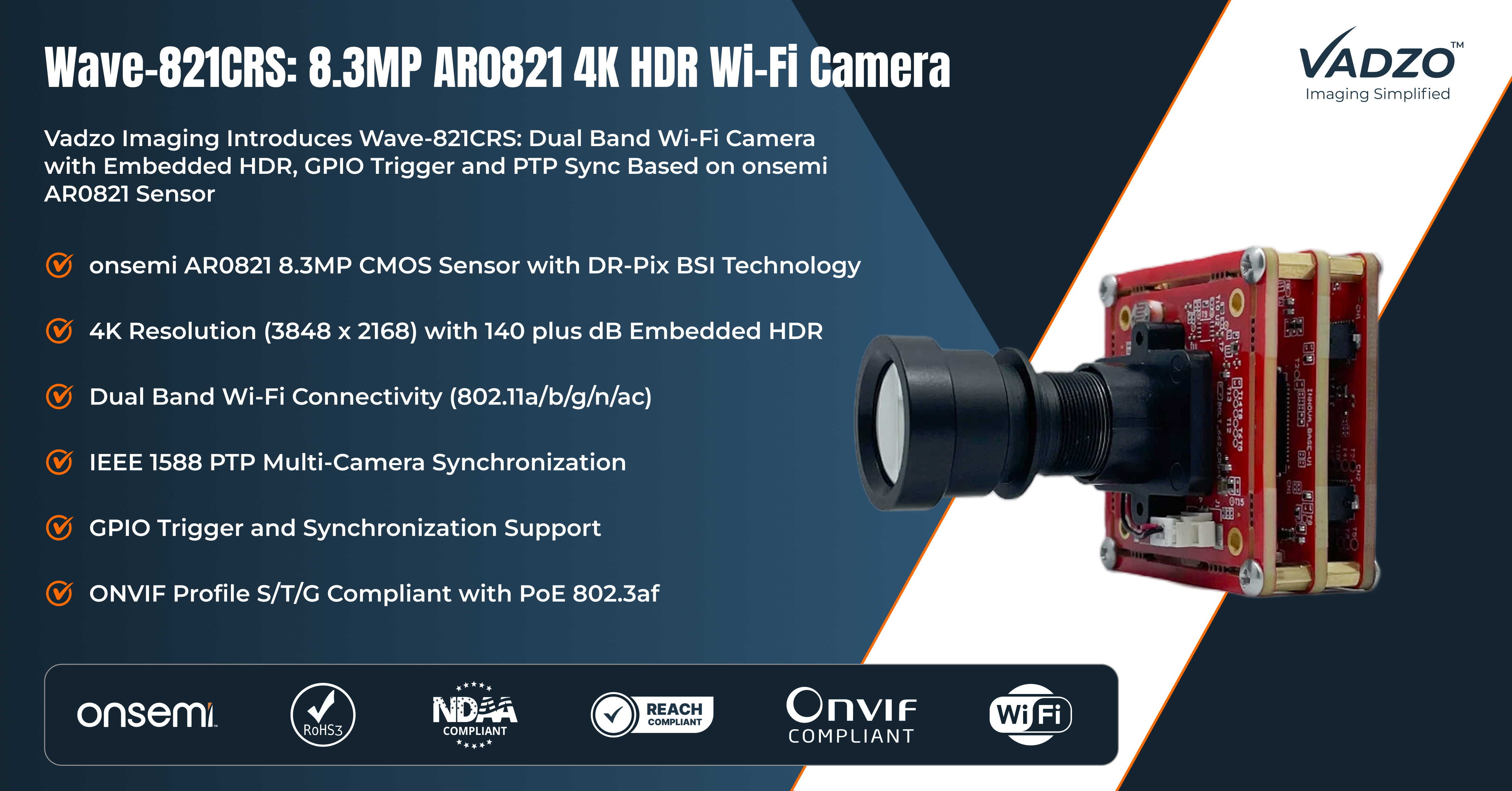
Sensor and Camera Overview
The Wave-821CRS is built on the onsemi AR0821, a 1/1.7-inch CMOS digital image sensor with a 3848 x 2168 active pixel array and 2.1 µm backside illuminated pixels using onsemi’s DR-Pix dual conversion gain pixel technology, positioning the Wave-821CRS as an Onsemi AR0821 WiFi Camera built around a native color Bayer filter array. Conventional HDR imaging typically stitches together multiple exposures captured at different shutter times, a method that introduces motion artifacts and ghosting whenever a subject moves between exposures, a persistent problem for machine vision systems tracking people, vehicles, or parts on a line. DR-Pix addresses this at the pixel level by switching between a high and low conversion gain within a single readout, letting the AR0821 capture full dynamic range from one exposure rather than several. The result is ≥140 dB embedded HDR (4-exposure eHDR mode) with no motion artifacts, which is why the Wave-821CRS operates as an 8MP HDR WiFi Camera, resolving bright highlights and dark shadow detail without the temporal smearing that multi-exposure HDR wireless camera module designs introduce. The sensor also supports 2×2 binning, scaling, and mono summing modes that improve low-light sensitivity, along with in-pixel windowing for flexible region-of-interest configuration.
Key specs: 8.3MP AR0821 CMOS Sensor (1/1.7 inch, 2.1 µm DR-Pix BSI pixel) | Rolling Shutter | Color | 140 plus dB Embedded HDR | Dual Band Wi-Fi (802.11a/b/g/n/ac), Bluetooth BT 5.0 on request | S-Mount (M12) with Electromechanical IR-Cut Filter | 105 degree DFOV | PoE IEEE 802.3af | -30C to +85C Operating Temperature | 38mm x 38mm, Three Boards | Windows, Linux, Android | ONVIF Profile S/T/G, RoHS 3, REACH
Key Capabilities of the AR0821 4K HDR Wi-Fi Camera
Embedded HDR Through In-Pixel Dual Conversion Gain: Machine vision and surveillance deployments that face both direct sunlight and deep shadow in the same field of view have historically needed either a multi-exposure HDR wireless camera module that risks ghosting on moving subjects, or a fixed exposure camera that clips highlights or crushes shadows entirely. The Wave-821CRS resolves this trade-off with the AR0821’s DR-Pix technology, performing dual conversion gain switching inside every pixel during a single exposure rather than across sequential frames. This gives the Wave-821CRS greater than 140 dB of dynamic range while remaining a true 4K HDR Wireless Camera with no frame blending artifacts, an important distinction for any AR0821 HDR Wi-Fi Camera intended for scenes with moving people, vehicles, or conveyor parts. Three exposure, four exposure, and line interleaved HDR modes are all available, giving integrators control over dynamic range depth versus frame rate.
Dual Band Wi-Fi Connectivity and ONVIF Compliance: As a 4K Dual-Band Wi-Fi Camera, the Wave-821CRS supports IEEE 802.11a/b/g/n/ac across the 2.4 GHz and 5 GHz spectrum. The 5 GHz band reduces co-channel interference in facilities running dense wireless infrastructure, while 2.4 GHz extends effective range through walls and across larger open areas, giving integrators a single 8MP Dual Band Camera platform tuned to the RF environment of each site rather than requiring separate hardware per band. Full ONVIF Profile S, T, and G compliance means the Wave-821CRS functions as a standards-based 8MP ONVIF Color WiFi Camera that plugs into existing video management systems and network video recorders without custom drivers, an advantage for OEM WiFi Camera Module buyers replacing legacy analog or wired infrastructure incrementally.
IEEE 1588 PTP Synchronization for Multi-Camera Systems: Wireless camera networks that rely on multiple units covering overlapping fields of view need a frame-level timing agreement to make downstream analytics, stitching, or triangulation meaningful. Without synchronization, two Wi-Fi camera products observing the same event can report timestamps that drift by tens of milliseconds, enough to break motion correlation across views. The Wave-821CRS addresses this with IEEE 1588 Precision Time Protocol support, letting multiple units converge on a shared clock reference for frame-accurate multi-camera coordination, positioning the Wave-821CRS as more than a Onsemi 8MP Wireless Camera for single-point capture and instead as infrastructure for a distributed, time-correlated vision network across a site.
GPIO Triggering for Vision Integration: General-purpose input/output pins on the Wave-821CRS support external trigger and synchronization signaling, turning the camera into a GPIO Trigger Wi-Fi Camera that can be fired from a PLC, sensor, or another unit on the network rather than relying on continuous free-running capture. This matters for inspection and access control scenarios where a frame must be captured at a precise mechanical or event-driven moment. As a WiFi GPIO Trigger Camera, the Wave-821CRS also supports output signaling for downstream automation, functioning as a GPIO Enabled Vision Camera in cells where lighting strobes or alarms need to fire in lockstep with capture. This makes the Wave-821CRS a practical AR0821 GPIO Camera for retrofit installations where running a dedicated trigger cable is impractical.
Power over Ethernet and Deployment Flexibility: The Wave-821CRS receives power over the same Ethernet cable used for network configuration and firmware management, compliant with IEEE 802.3af operating at 36 to 57V, even though image data itself travels over the Wi-Fi radio. This hybrid approach lets integrators run a single cable to each mounting point for power while keeping the camera untethered for data, a useful combination for a Dual Band WiFi Module deployed on poles, gantries or mobile fixtures where routing a full data cable is the harder constraint. The -30°C to +85°C operating range supports both indoor industrial floors and outdoor infrastructure through seasonal temperature swings.
Product Specifications
|
Product Family
|
Wave Series
|
|
Camera Model
|
Wave-821CRS
|
|
Sensor
|
AR0821 CMOS Sensor from onsemi
|
|
Sensor Format
|
1/1.7 inch
|
|
Pixel Size
|
2.1 µm x 2.1 µm
|
|
Max Resolution
|
8.3MP, 3848(H) x 2168(V)
|
|
Shutter
|
Rolling Shutter
|
|
Chroma
|
Color
|
|
Dynamic Range
|
140+ dB Embedded HDR (DR-Pix dual conversion gain)
|
|
HDR Modes
|
3-exposure eHDR, 4-exposure eHDR, line-interleaved HDR
|
|
Optics
|
S-Mount (M12 Standard) with Auto Switch IR-Cut Filter
|
|
Lens FOV
|
105° DFOV
|
|
Interface
|
Dual Band Wi-Fi (802.11a/b/g/n/ac), Bluetooth BT 5.0 (on request)
|
|
Power
|
Power over Ethernet, PoE 802.3af, 36 to 57V
|
|
Operating Temperature
|
-30°C to +85°C
|
|
Dimension
|
Three Boards, 38mm (L) x 38mm (B)
|
|
Weight
|
25 g (without lens)
|
|
OS Supported
|
Windows, Linux, Android
|
|
Conformity
|
ONVIF Compliant, RoHS 3, REACH
|
“Wireless HDR imaging has always forced a compromise between dynamic range accuracy and clean motion capture. With the Wave-821CRS we wanted to remove that compromise using the AR0821’s in-pixel dual conversion gain rather than software stitching, so integrators get true single-exposure HDR without ghosting on moving subjects. Pair that with dual-band Wi-Fi, PTP synchronization for multi-camera networks and GPIO triggering, and you have a camera product that lets OEMs deploy accurate, time-correlated vision networks without running dedicated data cable to every mounting point.” – Alwin Vincent, Product Manager at Vadzo Imaging.
Applications
Security and Video Surveillance: Perimeter security, retail loss prevention and building access control all depend on resolving detail in scenes where doorways, parking areas or building entries sit in shadow against bright exterior light, exactly the condition that defeats single-exposure fixed-range imaging. The Wave-821CRS’s embedded HDR addresses this directly, functioning as a Wireless Security Camera Module that captures usable detail across both the shadowed interior and sunlit exterior of an entryway in one frame. As a Surveillance Camera, the Wave-821CRS also benefits from ONVIF compliance Camera for direct integration into existing video management platforms, and GPIO triggering allows the camera to be fired in coordination with door contacts or motion sensors rather than running continuously.
Smart City and Multi Camera Infrastructure: Smart City camera networks across intersections, transit corridors and public infrastructure require wireless flexibility for installation without new cable runs, and frame-accurate timing across units observing the same intersection from different angles. The Wave-821CRS’s IEEE 1588 PTP support gives smart city integrators 4K Wireless Camera platform where multiple units can be correlated for downstream analytics such as vehicle tracking across camera boundaries, while dual-band Wi-Fi keeps installation practical across sites where trenching new Ethernet runs is costly.
Industrial Automation, Robotics and Machine Vision: Automated guided vehicles, autonomous mobile robots and fixed inspection stations on a production floor frequently operate under mixed lighting from overhead fixtures, natural light through bay doors and reflective metal surfaces, conditions where a WiFi Machine Vision Camera with embedded HDR avoids the blown highlights that defeat part inspection and barcode reading. As a Dual Band Industrial Camera, the Wave-821CRS’s untethered connectivity suits AGV and AMR platforms where a wired data connection is not physically possible, while GPIO triggering supports synchronized capture with conveyor encoders or robotic arm cycles. For fixed inspection points, the same sensor functions as a Wireless Inspection Camera capable of resolving both engraved detail and glare-prone reflective surfaces in a single pass, making the Wave-821CRS a practical AR0821 Wireless Camera for teams standardizing on one sensor platform across mobile and fixed vision points on the same line.
Vadzo NXT Software and SDK Support
The Wave-821CRS can be evaluated immediately using Vadzo’s NXT software for IP configuration and streaming, giving engineers a working 4K Wireless Camera on the network within minutes of power up. For teams building custom applications, the Vadzo NXT SDK exposes advanced exposure management, HDR mode selection between 3-exposure, 4-exposure, and line interleaved modes, and image tuning APIs across Windows, Linux, and Android, so the Wave-821CRS functions as a genuinely Plug and Play WiFi Camera for evaluation while still offering the programmatic depth that production integrations require. This tiered access, from immediate NXT software streaming through to full SDK control, is designed to shorten the path from bench evaluation to deployed OEM WiFi Camera Module without requiring a rebuild of the control stack partway through a project.
Frequently Asked Questions
Q: What is a dual band Wi-Fi camera and why does it matter for industrial deployments?
A: A dual band Wi-Fi camera support both the 2.4 GHz and 5 GHz frequency bands rather than being locked to one, letting integrators choose the band best suited to a site’s RF conditions. The 5 GHz band offers higher throughput and less interference in facilities already running dense wireless infrastructure, while 2.4 GHz extends an effective range through walls and across larger open areas where fewer access points are available. Vadzo Imaging’s Wave-821CRS is built around this exact requirement, pairing 802.11a/b/g/n/ac dual-band Wi-Fi with ONVIF Profile S, T, and G compliance so the camera integrates directly with existing video management software regardless of which band an integrator selects. For industrial sites, this flexibility means the same 4K Wi-Fi Camera can be deployed across a warehouse floor with heavy 2.4 GHz congestion from other wireless equipment or across a modern facility standardized on 5 GHz, without needing two different camera products to cover both scenarios.
Q: How does GPIO trigger work on a wireless machine vision camera?
A: GPIO triggering allows a camera to capture a frame in response to an external electrical signal, such as a PLC output or a photoelectric sensor, rather than continuously streaming frames and hoping the right moment falls within the buffer. This is essential inspection and access control scenarios where the meaningful frame corresponds to a precise mechanical or event-driven moment. The Wave-821CRS supports GPIO for exactly this purpose, functioning as a GPIO Trigger Camera Module that can also output signals to fire lighting strobes or downstream automation in sync with capture. Because the Wave-821CRS is wireless, this extends to mounting points where running a dedicated trigger cable alongside network cable would otherwise be impractical.
Q: What is embedded HDR and how is it different from multi-exposure HDR stitching?
A: Embedded HDR refers to a dynamic range of processing performed inside the pixel during a single exposure, rather than combining several sequential frames captured at different exposure times. Multi-exposure stitching is prone to motion artifacts and ghosting whenever a subject moves between the frames being combined, a common failure mode in surveillance and machine vision scenes with people or vehicles in motion. The onsemi AR0821 sensor at the core of Vadzo’s Wave-821CRS uses DR-Pix dual conversion gain technology to switch between high and low conversion gain within a single readout, delivering greater than 140 dB of dynamic range without the temporal artifacts of frame stitching. This makes the Wave-821CRS a true AR0821 HDR Wi-Fi Camera suited for scenes where lighting extremes and subject motion occur together, historically difficult to resolve with wireless camera platforms.
Q: Which WiFi camera supports IEEE 1588 PTP synchronization for multi-camera networks?
A: A WiFi camera capable of IEEE 1588 Precision Time Protocol synchronization lets multiple wireless units converge on a shared clock reference so timestamps stay accurate to the millisecond across a distributed network, which is essential for any analytics that correlate footage across overlapping fields of view. Vadzo Imaging’s Wave-821CRS is one of the few dual-band WiFi camera products on the market with built-in IEEE 1588 PTP support, positioning it as more than an Onsemi 8MP Wireless Camera for single-point capture and instead as infrastructure for time-correlated smart city and industrial WiFi camera networks. Without this kind of synchronization, two wireless cameras observing the same event can drift by tens of milliseconds, enough to break vehicle tracking, multi-camera stitching, or triangulation across a corridor or production floor.
Q: Does Vadzo Imaging offer SDK support for building custom WiFi camera applications?
A: Yes, Vadzo Imaging provides the Vadzo NXT SDK to customers building custom applications around its WiFi camera portfolio, giving developers programmatic control over exposure management, HDR mode selection, and image tuning parameters across Windows, Linux, and Android. On the Wave-821CRS specifically, this includes control over the AR0821’s 3-exposure, 4-exposure, and line interleaved eHDR modes, letting integrators tune dynamic range behavior to their exact scene rather than accepting a fixed HDR profile out of the box. Teams can also start with Vadzo’s NXT software for immediate IP configuration and streaming before committing to full SDK integration, which makes Vadzo a practical OEM WiFi Camera Module partner for teams at any stage of development, from bench evaluation through production deployment.
Availability
The Wave-821CRS, an 8.3MP AR0821 4K Wireless Camera with embedded HDR, is available for evaluation and production orders. Evaluation kits include the camera product, M12 lens assembly, Ethernet cable, and Vadzo NXT SDK documentation with no minimum order requirement. Visit the 4K HDR Wi-Fi Camera product page or contact Vadzo at support@vadzoimaging.com
About Vadzo Imaging
Vadzo Imaging is a global provider of embedded vision solutions, delivering high-performance camera technologies and imaging platforms for robotics, industrial automation, UAVs, edge AI and smart infrastructure. Its camera products integrate with leading embedded platforms such as NVIDIA Jetson, Raspberry Pi, Qualcomm RB series, and NXP i.MX. As a WiFi Camera Manufacturer, Vadzo supports customers through hardware customization, firmware development, and its Vadzo NXT SDK. Explore the full Vadzo Wi-Fi camera portfolio or visit www.vadzoimaging.com.
Media Contact
Alwin Vincent
Vadzo Imaging
Email: alwin@vadzoimaging.com
LinkedIn: Vadzo Imaging
YouTube: Vadzo Imaging
X: Vadzo Imaging
SOURCE: Vadzo Imaging
View the original press release on ACCESS Newswire
Media gallery