
FireFox Gold Drills 6.15m at 4.10 g/t Gold at Gabbro Target, Further Expanding Gold Footprint at Mustajärvi Project, Lapland, Finland
SODANKYLÄ, FINLAND / ACCESS Newswire / November 5, 2026 / FireFox Gold Corp. (TSXV:FFOX)(OTCQB:FFOXF) ("FireFox" or the
Press Release Disclaimer: This is a press release distributed through the XPR Media network. It has not been independently verified by our newsroom.


SODANKYLÄ, FINLAND / ACCESS Newswire / November 5, 2026 / FireFox Gold Corp. (TSXV:FFOX)(OTCQB:FFOXF) (“FireFox” or the “Company”) is pleased to announce the results of four additional holesat its 100%-owned Mustajärvi Gold Project in Lapland, Finland. Two holes tested the sparsely-drilled Gabbro Target and successfully intersected strong gold mineralization, including:
- 26MJ057: 6.15 metres averaging 4.10 g/t gold, including 1.05 metre at 14.65 g/t Au from 224.15 metres depth.
The Gabbro Target is to the west of the main gold lodes at Mustajärvi, and this new intercept increases the strike extent of gold-bearing drill holes along the Mustajärvi Shear Zone (MSZ) to more than 2.5 kilometres. (Figure 1). Hole 26MJ057 targeted a conductor from a recent fixed loop electromagnetic (FLEM) geophysical survey. The newly intersected high-grade mineralization around the gabbro body significantly elevates the prospectivity of this target, particularly as there are additional large FLEM and borehole EM (BHEM) targets modelled in the area that warrant immediate follow-up drilling. A second hole, collared farther east in the Gabbro Target to test a strong magnetic low, also returned some narrow but significant gold intercepts.
Twoother reconnaissance drill holes tested the previously undrilled Triangle Target approximately 500 metres north of the Northeast Zone and the main Mustajärvi trend (Figure 1). Both holes confirmed the interpreted north-south structure believed to host gold mineralization in the area, and returned significant intervals including:
- 26MJ037: 2.7 metres averaging 2.15 g/t gold, including 0.95 metres at 3.58 g/t gold from 72.3 metres depth; and
- 26MJ036: 1.0 metre at 2.8 g/t gold from 108.0 metres depth.
Carl Löfberg, FireFox’s CEO, commented “Once again, our systematic program execution has resulted in significant expansion of the known gold mineralization at Mustajärvi. This is the third time during this program that FLEM has guided our drill to strong gold results, in this case illuminating a target that was slightly deeper than we had previously drilled in this area. The team quickly followed up with a down-hole BHEM survey, and the modelling suggests that a larger conductive target remains to be tested. Significant gold intercepts in the Gabbro Target have been elusive, but the gabbro is potentially a good host rock and we now have several structural and geophysical targets to test. Given the wide spacing and shallow depths of existing drilling in these new targets, these initial drill hits with strong gold grades and nearly identical geochemistry and alteration to the main zones are very favorable for potential growth in these areas. We are planning to bring a drill back to the Gabbro Target very soon. The new test of the Triangle Target, well away from any previous drilling, is another meaningful success. We have confirmed the presence of a potentially important structure there, and we have only scratched the surface with these holes.”
Mustajärvi Project and Details of Drill Results
The Mustajärvi Project lies along the highway between the cities of Kittilä and Sodankylä, approximately 18 kilometres east of Kittilä. FireFox and predecessor companies drilled approximately 15,752 metres prior to commencement of the current program and delineated three different lodes of gold mineralization striking more than two kilometres along the Mustajärvi Shear Zone (MSZ). In addition to expanding and infilling those lodes, this program has identified a fourth zone of high-grade gold, named Lammas, situated on a parallel structure nearly a kilometre east of the MSZ. The Gabbro Target sits along the MSZ to the west of the three main zones, while the Triangle Target is situated to the north along an interpreted cross structure. Inclusive of these drill holes, the total drilling on the project is now 31,070 metres.
Gabbro Target
The area is mapped as intrusive (gabbro) rather than volcanic and metasedimentary rocks, which dominate most of the permit area. Gabbro is a common host rock in orogenic gold systems around the world. Large structures exhibiting strong alteration are interpreted in the area, but previous widely-spaced shallow drilling returned limited gold results. Lately, FireFox has successfully employed FLEM surveying elsewhere on the Mustajärvi property, where several conductive targets yielded successful drill tests. These conductivity anomalies have often been shown to reflect hydrothermal pyrite mineralization, which is often associated with high-grade gold on the property. Both the East and Lammas Zones were discovered, in part, with guidance from FLEM surveys. FireFox recently completed an expanded FLEM survey that identified additional conductive rocks at the Gabbro Target.
Drill hole 26MJ057 tested an extensive modelled FLEM conductor plate, which coincides with a discontinuity in the ground magnetic data. The hole was collared 125 metres northwest of hole 21MJ007, and it was drilled more steeply to test the deeper FLEM plate. The hole passed through approximately 4.6 metres of glacial sediment before entering massive, homogeneous gabbro. The drill hole entered a volcano-sedimentary sequence at 167.85 metres depth. It intersected one broad, high-grade gold interval beginning at a depth of 221.0 metres and yielding 6.15 metres averaging 4.10 g/t Au, including 1.05 metres at 14.65 g/t Au from a depth of 224.15 metres. The mineralized interval was coincident with the approximate location of the conductive plate interpreted from the FLEM survey and refined by modeling of the BHEM in three dimensions. Gold in this new area is associated with pyrite mineralization occurring as disseminated grains, patches, and semi-massive bands hosted in intensely albite- and silica-altered metasedimentary rocks intercalated with sericite-altered mafic and ultramafic rocks. The high-grade interval of 1.05 metres at 14.65 g/t Au is associated with massive pyrite hosted in a quartz vein. The multielement geochemistry confirms that the high-grade gold in this interval is associated with strongly elevated bismuth, tellurium, and cobalt grades.
After drilling, team geophysicist Markku Montonen of Magnus Minerals directed and interpreted a BHEM survey on drill hole 26MJ057. The resulting BHEM conductor plate model indicated a conductive anomaly significantly larger in extent than previously identified conductivity anomalies at Mustajärvi. The Company considers the area and the new conductivity anomaly highly prospective for further mineralization and is planning a follow-up drill program.
Drill hole 26MJ058 targeted a strong magnetic low visible in the Company’s detailed ground magnetic survey that was interpreted as the contact between the large gabbro body and metasedimentary country rocks. The hole was collared 204 metres southwest of 26MJ027 and 400 metres east-northeast of 26MJ057, at the easternmost edge of the intrusive gabbro. It passed through approximately 11.0 metres of glacial sediment before entering massive gabbro. The contact with intensely albite- and silica-altered metasedimentary rocks was encountered at a downhole depth of 37.9 metres. The first mineralized interval was intersected from a depth of 124.0 metres and returned 2.25 metres averaging 1.7 g/t Au. Gold in this interval is associated with pyrite occurring as veinlets and patches that infill fractures in albite- and sericite-altered metasedimentary rocks. This interval lies in the hanging wall of a faulted and sheared mafic intrusive unit.
Two additional gold intervals were encountered deeper in the hole, both of which were one metre or less in thickness and were associated with pyrite and quartz veining in metasedimentary rocks.
Triangle Target
The Triangle Target lies on the opposite side of the two-lane highway from the main Mustajärvi tenement area, approximately 500 metres north of the Northeast Zone and approximately 600 metres northeast of the East Zone (see Figure 1).
Earlier surface sampling and excavation at the Triangle Target identified gold mineralization associated with a hematite-rich hydrothermal alteration zone on a suspected north-south-trending fault. Previous sampling results included one-metre diamond-saw cuts from outcrop grading 1.83 g/t and 1.43 g/t gold and grab samples grading 4.82 g/t and 4.41 g/t gold (see the Company’s news releases dated January 16, 2025 and September 17, 2024). Reconnaissance drilling at the Triangle Target was guided by the Company’s detailed geological mapping, trenching, and geophysical surveys combining ground magnetic (GMAG) and very-low-frequency electromagnetic (VLF) measurements. VLF measurements are effective at detecting near-surface, low-resistivity or conductive features that often coincide with mineralized zones at the Mustajärvi Project. The survey was initiated to better define a suspected north-south structure believed to host gold mineralization and to trace it southward toward the Mustajärvi Shear Zone, where previous attempts to map the fault using detailed GMAG data alone did not produce optimal results. The combined GMAG-VLF survey successfully outlined the structure and highlighted zones of potentially mineralized, low-resistivity material. The data also revealed a disruption or bend in the local structures, further enhancing prospectivity of the surface mineralized target.
Drill hole 26MJ036 was collared in the northernmost part of the Triangle Target, approximately 430 metres north of the nearest drill hole collared between the Northeast and East Zones. The hole passed through approximately 5.9 metres of glacial sediment before entering chlorite- and sericite-altered metasedimentary rocks. The hole encountered one gold-mineralized interval beginning at 108.0 metres downhole that returned 1.0 metre at 2.8 g/t Au. Gold is associated with quartz-carbonate veins containing patchy pyrite, and hematite within albite-, silica-, and sericite-altered metasedimentary rocks. The mineralized veins are associated with semi-brittle deformation. The quartz-carbonate veins encountered here also contain patchy barite, which is relatively unusual at Mustajärvi but has been observed at the Lammas and East Zones.
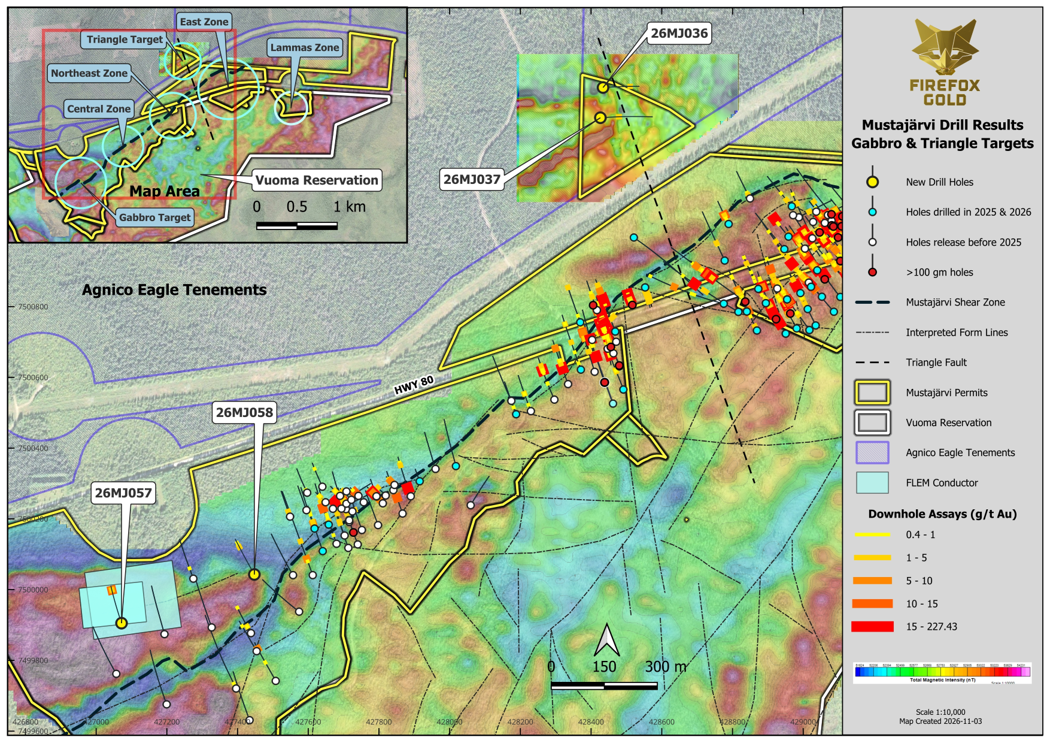
Figure 1. Gabbro and Triangle Targets at Mustajärvi with the Locations of Drill Holes 26MJ057, 26MJ058, 26MJ036, and 26MJ037.
Drill hole 26MJ037 was collared 85 metres south of hole 26MJ036 and tested the same interpreted north-south structure. The hole passed through thin glacial sediments before entering weakly altered metasedimentary rocks. It intersected a single gold interval beginning at a depth of 72.3 metres, which yielded 2.7 metres averaging 2.15 g/t Au, including 0.95 metres at 3.58 g/t Au. The gold in this interval is associated with fractured quartz-carbonate-barite veins containing disseminated and patchy pyrite and hematite. The veins are hosted in a deformed, strongly albite-, silica-, and sericite-altered contact zone between a mafic dyke and metasedimentary rocks. Multi-element analyses reveal the typical association of gold with strongly elevated bismuth, tellurium, and cobalt, as observed in most of the mineralized lodes at the Mustajärvi Project.
Table 1. Drill Intercepts in Drill Holes 26MJ036, 26MJ037, 26MJ057, and 26MJ058
(Cut-off Grade 0.3 g/t Au)
|
Drill Hole |
From (m) |
To (m) |
Interval (m) |
Au Grade (g/t) |
|
|
26MJ036 |
108.0 |
109.0 |
1.0 |
2.80 |
|
|
26MJ037 |
72.3 |
75.0 |
2.7 |
2.15 |
|
|
Including |
72.3 |
73.25 |
0.95 |
3.58 |
|
|
26MJ057 |
221.0 |
227.15 |
6.15 |
4.10 |
|
|
Including |
224.15 |
225.2 |
1.05 |
14.65 |
|
|
26MJ058 |
124.0 |
126.25 |
2.25 |
1.70 |
|
|
141.0 |
142.0 |
1.0 |
0.97 |
||
|
143.9 |
144.8 |
0.9 |
0.57 |
||
|
All intervals are expressed as core width; true width has not yet been estimated. |
|||||
Table 2. Drill Collar Information (coordinates presented in EPSG:3067)
|
Drill Hole |
Easting |
Northing |
Azimuth (°) |
Dip (°) |
Depth (m) |
|
26MJ036 |
428433.9 |
7501419.4 |
90 |
45 |
143.0 |
|
26MJ037 |
428426.5 |
7501334.0 |
90 |
45 |
201.1 |
|
26MJ057 |
427071.8 |
7499905.2 |
340 |
65 |
251.2 |
|
26MJ058 |
427447.5 |
7500042.9 |
330 |
45 |
160.8 |
Methodology & Quality Assurance
The core was transported from the rig to the Company´s core storage facility in Sodankylä, where FireFox’s exploration team conducted the geological and geotechnical logging and selected the assay intervals. Assay intervals were generally 1 metre but in some circumstances were modified according to lithological boundaries and other factors. FireFox geologists maintained chain of custody and sampling procedures according to best industry practice and with due attention to quality assurance and quality control, including ¼ core duplicates, crush stage duplicates, and insertion of certified standard and blank samples.
FireFox team members transported the samples to an ALS sample prep lab in Sodankylä. The samples were sawed then crushed to -2 mm, split and pulverized into 1kg pulps, before being shipped to the ALS facility in Rosia Montana, Romania for gold by fire assay of 50 gm aliquots with AAS finish (method Au-AA26). All samples exceeding 50.0 g/t Au were re-assayed with a gravimetric finish (method Au-GRA22). Other elements, altogether 48, were measured after four-acid digestion by ICP-AES and ICP-MS (method ME-MS61) at the ALS facility located in Loughrea, Ireland. ALS Laboratories is a leading international provider of assay and analytical data to the mining industry. All ALS geochemical hub laboratories, including the Irish facility, are accredited to ISO/IEC 17025:2017 for specific analytical procedures.
Part of the drill core samples in this news release were assayed at the Eurofins Labtium Oy laboratory in Sodankylä, Finland, where half core samples were crushed, pulverized and split with a riffle splitter. The lab performed Pb-Fire Assay for gold on 50-gram aliquots followed by ICP-OES determination (method 705P). In some cases where satisfactory fusion was not achieved, the Pb-Fire Assay was carried out on a smaller 30-gram subsample. In addition, a broad suite of elements was analysed by four-acid digestion followed by ICP-OES and ICP-MS determination (method 304PM1) at the Eurofins Ahma Oy laboratory in Oulu, Finland. Eurofins Labtium Oy and Eurofins Ahma Oy are accredited to the SFS-EN ISO/IEC 17025:2017 standard.
The Firefox QA/QC program consists of insertion of certificated standard material and blanks inserted by Firefox into the analytical batches did not show deviations from recommended values. No QA/QC issues were identified from a review of the analytical data discussed herein.
Patrick Highsmith, Certified Professional Geologist (AIPG CPG # 11702) and director of the Company, is a qualified person as defined by National Instrument 43-101. Mr. Highsmith has helped prepare, reviewed, and approved the technical information in this news release.
About FireFox Gold Corp.
FireFox Gold Corp is listed on the TSX Venture Stock Exchange under the ticker symbol FFOX. FireFox also trades on the OTCQB Venture Market Exchange in the US under the ticker symbol FFOXF. The Company has been exploring for gold in Finland since 2017 on a large portfolio of ground prospective for high-grade gold deposits. The delineation of multiple gold zones at the Company’s 100%-held Mustajärvi Project is paving the way for the discovery of Finland’s next major gold deposit.
Having a strong mining law and long mining tradition, Finland remains underexplored for gold. Recent exploration results in the country have highlighted its prospectivity, and FireFox is proud to have a Finland based CEO and technical team.
For more information, please refer to the Company’s website and profile on the SEDAR+ website at www.sedarplus.ca.
On behalf of the Board of Directors,
“Carl Löfberg”
Chief Executive Officer
CONTACT:
FireFox Gold Corp.
Email: info@firefoxgold.com
Telephone: +1-778-938-1994
Neither the TSXV nor its Regulation Services Provider (as that term is defined in the policies of the TSXV) accept responsibility for the adequacy or accuracy of the content of this release.
Forward Looking Statements
The information herein contains forward looking statements that are subject to a number of known and unknown risks, uncertainties and other factors that may cause actual results to differ materially from those anticipated in our forward-looking statements. Factors that could cause such differences include changes in world commodity markets, equity markets, the extent of work stoppage and economic impacts that may result from illness, extreme weather, changes in government and changes to regulations affecting the mining industry.
Forward-looking statements in this release may include statements regarding: the intent to conduct additional exploration; the belief as to the location of the most prospective gold targets; the location of targets for future exploration programs; and the current and future work program, including the extent and nature of exploration to be conducted in 2026. Although we believe the expectations reflected in our forward-looking statements are reasonable, results may vary.
The forward-looking statements contained herein represent the expectations of FireFox as of the date of dissemination and, accordingly, are subject to change after such date. Readers should not place undue importance on forward-looking statements and should not rely upon this information as of any other date. FireFox does not undertake to update this information at any particular time except as required in accordance with applicable laws.
SOURCE: FireFox Gold Corp
View the original press release on ACCESS Newswire
Media gallery
