
“Glory of Bronze Civilization: Sanxingdui-Jinsha Sites Salon” Held in Greece
Just another WordPress site
Press Release Disclaimer: This is a press release distributed through the XPR Media network. It has not been independently verified by our newsroom.
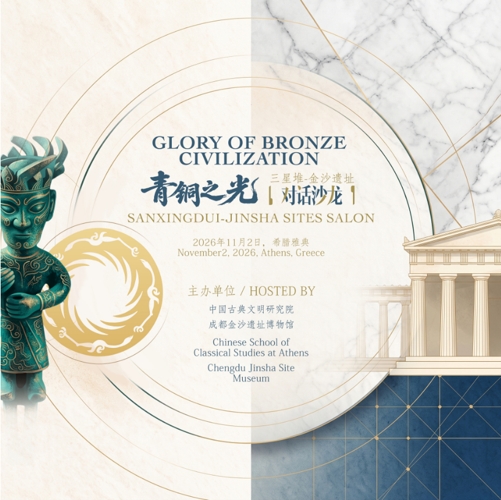

Athens, Greece – November 5, 2026 – On November 2, 2026, local time, the “Glory of Bronze Civilization: Sanxingdui-Jinsha Sites Salon” was held at the Chinese School of Classical Studies at Athens in Greece. The event was hosted by the Chinese School of Classical Studies at Athens and the Chengdu Jinsha Site Museum. Experts and scholars, university faculty members and students, and media representatives from China and Greece attended the event.
Main visual of the event.
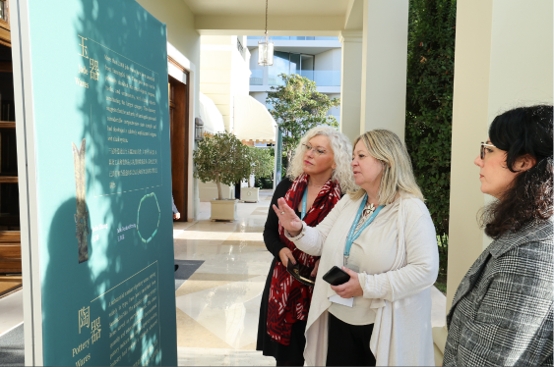
Visitors explore the “Glory of Bronze Civilization: Sanxingdui-Jinsha Sites Exhibition”.
To introduce the Greek public to the ancient Shu civilization, the event specially set up the “Glory of Bronze Civilization: Sanxingdui-Jinsha Sites Exhibition” in the outdoor and indoor spaces of the Chinese School of Classical Studies at Athens. Opening with illustrated panels on the geographical location, site overview, and representative artifacts of the Sanxingdui-Jinsha Sites, the exhibition led visitors into the ancient Shu civilization in southwestern China. Through the combination of illustrated panels and 3D-printed replicas of representative exhibits, the exhibition vividly presented the unique artifact forms, artistic aesthetics, and spiritual beliefs of the ancient Shu civilization and offered a platform for Greek visitors to gain a closer understanding of the Sanxingdui-Jinsha Sites. It provided a tangible visual reference for the keynote speech by Zhang Qing, Director of the Chengdu Jinsha Site Museum, during the expert salon.
Georgios Steiris, President of the Department of Philosophy of the National and Kapodistrian University of Athens, mentioned in an interview that he had visited the Sanxingdui Museum and the Jinsha Site Museum in person two years ago. “If you see the real artifacts there with your own eyes, they will deliver the greatest impact.” In his view, what was most impressive was not the objects themselves, but the “spiritual connotations behind the artifacts”—“They are not merely decorations trying to create a sense of beauty, but the ways through which ancient artisans sought to establish a connection with deities and the surrounding nature.”
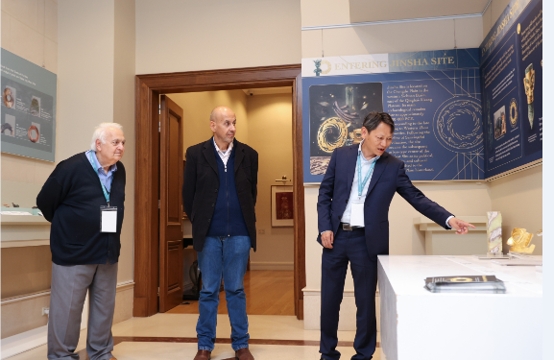
Director Zhang Qing guides Greek experts through the exhibition.
The afternoon salon was moderated by Li Xinwei, Director of the Chinese School of Classical Studies at Athens. The event opened with the documentary Echoes of Civilization: Dialogue Between Chinese and Greek Civilizations, through which Chinese and Greek guests approached each other’s histories and spiritual worlds. During the salon discussion and Q&A session, Chinese and Greek experts exchanged views on topics such as the similarities and differences between the ancient Shu and ancient Greek civilizations, as well as the protection and inheritance of cultural heritage. They engaged with faculty members and students present. Agamemnon Tselikas believed that such intellectual exchange was “very, very important”, prompting him to consider visiting China again. He also expressed the hope “to enable younger students to come to Greece to discuss, exchange ideas, and learn… This exchange itself embodies the spirit of humanism.”
About Us
Jinsha site is the urban center of the ancient Shu Kingdom, the center of the ancient civilization of the upper reaches of the Yangtze River, from the 12th century BC to the 7th century BC (approximately 3,200-2,600 years ago). Its civilization, along with the Sanxingdui civilization, was two of the peaks of development in ancient Shu history. As the first major archaeological discovery in 21st century China, Jinsha site has excavated the densest collection of ivory, the most abundant gold and jade artifacts of any site dating back to the same period globally. The most famous Sun and Immortal Birds Gold Ornament, has been determined as the main pattern of China cultural heritage and the symbol of Chengdu’s urban image. The discovery of Jinsha site proves that Chengdu has an urban history of more than 3,000 years, thus being regarded as the starting point of Chengdu’s urban history. Jinsha site was named one of the Top Ten Archaeological Discoveries in China in 2001, a national key cultural relic protection unit and one of the first batch of national archaeology parks, and was included in the China World Cultural Heritage Reserve List, along with Sanxingdui site.
Media Contact
Company Name: JINSHA SITE MUSEUM
Contact Person: Jean Wong
Email: Send Email
Country: Greece
Website: https://www.jinshasitemuseum.com/site-75
